
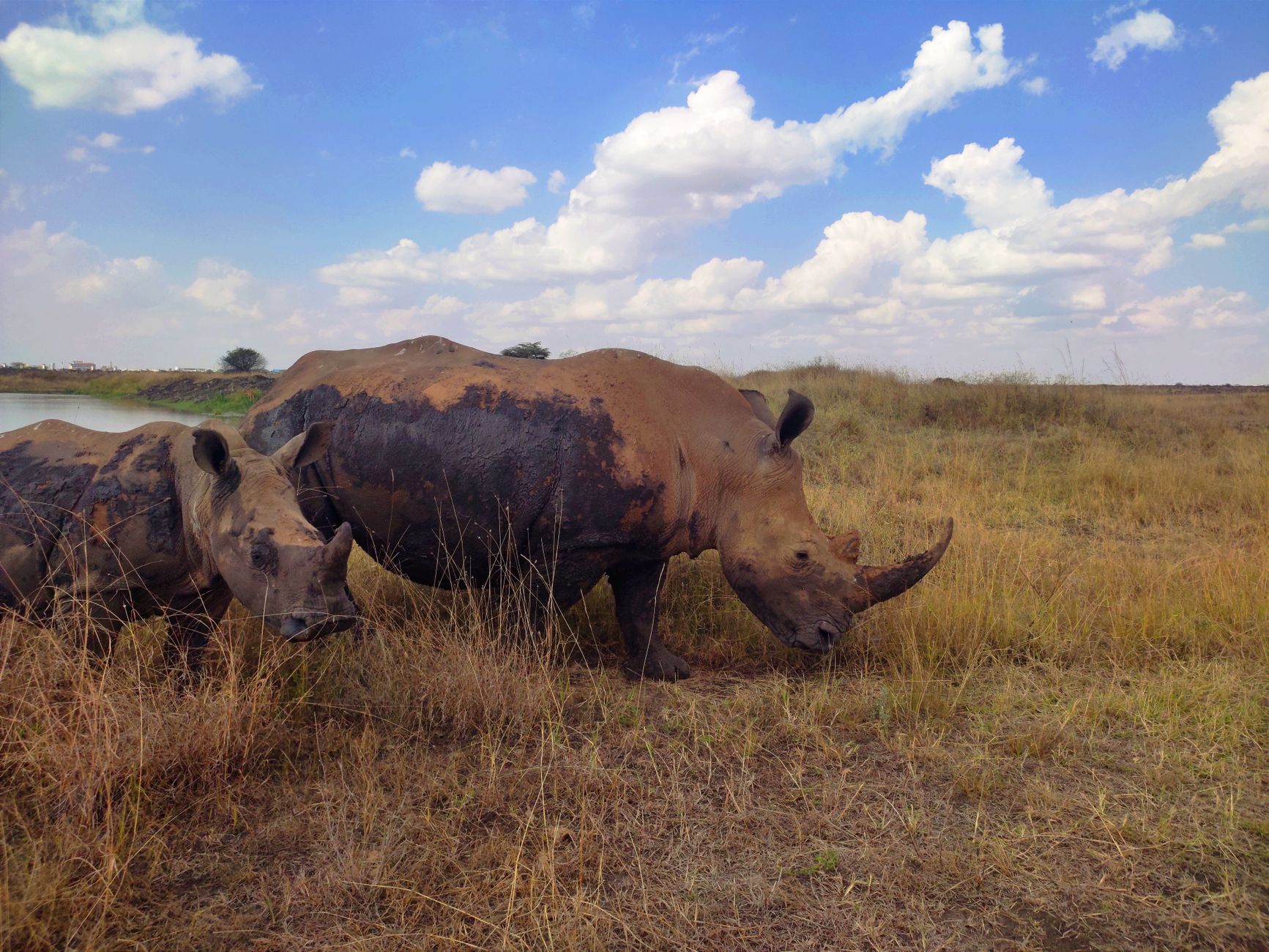
1. Nairobi National Park, at 6.30am
The park covers 117 square kilometres immediately south of the city, fenced on three sides and open to the Athi-Kapiti plains on the fourth, so animals still move in and out. Non-resident adult entry is roughly KSh5,600 and the main gate is on Langata Road, 20 minutes from Karen. Inside there are black and white rhino in reliable numbers, buffalo, giraffe, zebra, eland, hippo at the pools, and lion — often seen, never guaranteed. The skyline of Upper Hill behind a grazing rhino is the photograph that defines Nairobi.
Go at gate opening, 6am, and drive the Athi Basin and the hippo pools first. By 10am the light is flat and the minibuses have arrived. You need a vehicle with clearance; a small hatchback will manage the main circuits in dry weather but struggles in April and May. A half-day guided drive with pickup from your hotel costs roughly KSh8,000-14,000 per person including park fees for two people, which is the right call if you are not driving. Three hours is enough; five is better.
2. The Sheldrick orphan elephant nursery
The David Sheldrick Wildlife Trust nursery, inside the park boundary off Magadi Road, opens to the public for one hour from 11am daily, and it is the most affecting hour in Nairobi. Orphaned elephant calves come in from the bush for milk and a mud bath while keepers explain each animal's story. Entry is roughly KSh2,000 for non-resident adults and must be booked in advance online — walk-ups are turned away. Fostering a calf, from about KSh6,500 a year, buys access to the quieter 5pm private visit.
Two honest notes. It is crowded: 200 people can be pressed against a rope in a semicircle, so arrive at 10.30am to get a spot near the mud wallow rather than behind three rows. And it is short — you will be back in the car by 12.10pm. Pair it with the Giraffe Centre 15 minutes away and lunch in Karen for a complete morning. Even with the crowd, the sight of a two-year-old elephant knocking a keeper over for a bottle wins over anything else on this list.
3. The Giraffe Centre, and how to time it
The Giraffe Centre on Duma Road in Langata is a conservation programme for the endangered Rothschild's giraffe, and the raised wooden platform puts you eye to eye with animals that will take pellets from your hand. Entry is around KSh1,500 for non-resident adults, open 9am-5pm, and the whole visit takes 45 minutes. There is a small forest boardwalk into Gogo Falls woodland that almost nobody uses and which is worth the extra twenty minutes for the birdlife.
Timing is everything here. Between 10am and 12.30pm the platform fills with school groups and the Sheldrick overflow, and it becomes a scrum. Arrive at 9am sharp or after 3.30pm and you will have the giraffes largely to yourself. If your budget will not stretch to the famous Karen manor house where giraffes put their heads through breakfast-room windows — a stay there runs well north of KSh120,000 a night for two — this is the same animal at one per cent of the price.
4. Karura Forest: the best-value green space in Africa
Karura is 1,041 hectares of indigenous forest inside the city, entered from Limuru Road, Kiambu Road or the Old Kiambu Road gate, open 6am-6pm, at roughly KSh600 for non-resident adults. Inside are 50km of graded trails, a 15m waterfall, caves used by Mau Mau fighters, a bamboo grove, a marsh with birds and a river café. You will see Sykes monkeys, bushbuck, duiker, and around 200 bird species. It is safe, patrolled, and full of Nairobi residents running before work.
Rent a bike near the Limuru Road gate for about KSh500 an hour and do the waterfall loop; on foot it is a comfortable two hours. Weekend mornings are busy in the best way. This is the single cheapest thing on this list and the one I would keep if I could only keep one, because it shows you how Nairobi actually lives. Skip the Sunday afternoon car park chaos at the main gate by entering from the Old Kiambu Road side instead.
5-6. The Safari Walk, the Animal Orphanage and the Arboretum
The Nairobi Safari Walk, at the park's main gate, is a raised boardwalk through enclosures holding albino zebra, bongo, white rhino and big cats, at roughly KSh2,900 for non-resident adults. It is a zoo by another name, but it is well-kept and it works brilliantly with children under ten or on a rainy afternoon when a game drive is pointless. The adjoining Animal Orphanage is older, more cramped, and honestly skippable unless the children insist.
The Nairobi Arboretum, off State House Road, is free-to-cheap, 30 hectares, and holds over 350 tree species plus vervet monkeys and a big weekend picnic crowd. For birders, the marsh at the Arboretum and the Karura wetlands together deliver a solid list in a morning without leaving the city. Both are better uses of a spare two hours than any shopping mall, and both cost less than a coffee in Westlands. Neither will replace the park; both fill the gaps in an itinerary.
7-8. Oloolua Trail, Ngong Hills and the edge-of-city walks
The Oloolua Nature Trail in Karen, run by the primate research institute, is a 5km loop through riverine forest with a waterfall, a cave and a suspended bridge, at roughly KSh1,000-1,500 for non-residents. It is quieter than Karura and feels genuinely wild — colobus and Sykes monkeys, thick canopy, and few people on a weekday. Combine it with lunch in Karen and you have an easy, cheap half-day that most visitors never hear about.
For the big view, walk the Ngong Hills ridge: seven peaks, roughly 12km end to end at around 2,460m, with the Rift Valley falling away on one side and Nairobi spread out on the other. Rangers at the Ngong town gate charge a modest entry and armed escorts are available and worth taking. Start by 8am, allow four to five hours, carry water and a windproof layer. Finish with roast goat on the Magadi Road. It is the best day in the Nairobi area that does not involve a park fee.
9. The ones to skip, and the one to save for
Skip the roadside snake parks and the small private animal collections advertised on Langata Road; they add nothing after the Safari Walk. Skip any operator offering a lion sighting guarantee in Nairobi National Park — nobody can promise that, and the ones who try drive badly to deliver it. And skip walking safaris marketed inside the national park; the legal, sanctioned walking options are at the Safari Walk boardwalk and out at Crescent Island on Lake Naivasha, not in the park itself.
Save your money for one thing instead: a dawn Nairobi National Park drive on a weekday in July or August, when the grass is short, the migratory herds have moved onto the plains, and the visibility is at its annual best. Get a driver-guide with a proper 4x4 and a roof hatch, leave your hotel at 5.45am, and take breakfast in a box. Roughly KSh10,000-15,000 a head all in, and it delivers more than a two-day rushed trip to a distant reserve.
Questions, answered
How much is entry to Nairobi National Park?
Non-resident adults pay roughly KSh5,600, with lower rates for children, residents and citizens, and vehicle fees on top. Gates open at 6am. Pay by card or M-Pesa at the Langata main gate — cash is not accepted for park fees, so arrive with a working mobile-money account or a card.
Can you see lions in Nairobi National Park?
Yes, and sightings are frequent, but never guaranteed — the park holds a small resident population across 117 square kilometres. Rhino, buffalo, giraffe, zebra and hippo are close to certain on a three-hour morning drive. Go at 6am for the best chance and the best light.
Do I need to book the elephant orphanage in advance?
Yes. The Sheldrick nursery admits visitors only from 11am to noon and requires an advance online booking at roughly KSh2,000 for non-resident adults. Walk-ups are refused. Arrive by 10.30am for a spot near the mud wallow, and pair it with the Giraffe Centre 15 minutes away.
Doing good is the business: every booking through Stay Nairobi funds one verified tonne of carbon removal — same room, same price, no markup.
Start your search