
Hotel round-ups
Sustainable stays in Nairobi: lower-impact hotels and how to pick one
Nairobi's greenest hotels run on sun, boreholes and kitchen gardens rather than on a leaf logo, so here is how to read the four levers that matter and which park-edge, Karen and Gigiri stays actually pull them.
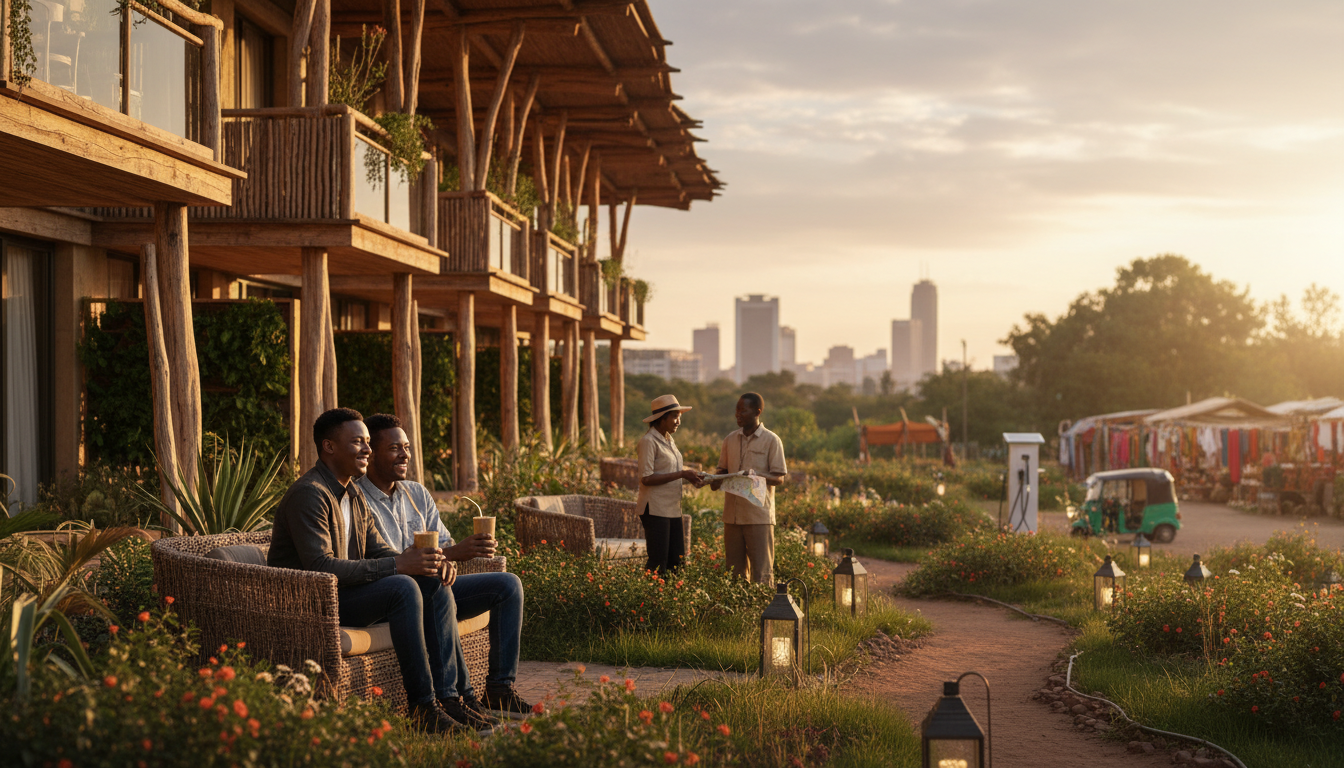
What lower-impact actually means in a city like Nairobi
Sustainability here is decided by four practical things, not by a leaf logo on a website. The first is power: Kenya Power's grid draws heavily on geothermal and hydro, so a hotel on mains is already lower-carbon than one idling a diesel generator through the city's frequent outages — a genuine green stay pairs a solar array with a lithium battery so the generator barely runs. The second is water. Nairobi Water rations supply across much of the city, so the honest hotels sink a borehole and recycle greywater onto the gardens rather than trucking in bowsers. Judge a place on these two before you look at anything else.
The third lever is what lands on your plate. Kenya's Rift Valley farms sit two hours away, so a kitchen that buys from Limuru, Kiambu and its own garden beats one flying in imported protein, and the better lodges run a visible market garden you can walk. The fourth is plastic. Kenya banned plastic bags outright in 2017 and single-use plastics inside national parks, forests and conservation areas from June 2020, so a camp within Nairobi National Park legally cannot hand you a throwaway water bottle — it refills glass or aluminium instead. Apply these four tests on the phone before booking and most greenwashing collapses on contact.
The one certification worth trusting, and the ones that follow it
The label to trust here is the Ecotourism Kenya eco-rating, a locally audited scheme that grades properties Bronze, Silver or Gold against energy, water, waste and community criteria, with each certificate valid two years and the graded list published online. Gold is rare and demanding; Silver is a solid signal; Bronze means a property has merely started. Cross-check any badge against that public register rather than taking the lobby plaque at face value, because certificates lapse and a two-year-old sticker proves nothing about this year. If a hotel claims eco-credentials and appears nowhere on the list, treat the claim as marketing and move on to the next.
Two international marks also turn up in Nairobi. Green Key, administered through Kenya's tourism federation, and Travelife, common on European-booked chains, both audit similar ground. They matter most at the big city hotels, where scale makes small percentage gains real: a 200-room tower that switches to solar water heating and LED lighting saves more absolute energy than a six-tent camp ever could. Ask one concrete question when you call — is your hot water solar or electric, and is the borehole metered. A front desk that answers precisely runs a real programme; one that only repeats the word eco is selling you a feeling. That single question sorts most of the field.
On the park's edge: the lowest-footprint beds in the county
The lowest-impact beds near the city sit inside and along the edge of Nairobi National Park, 20 minutes from the centre yet unfenced to the plains. Nairobi Tented Camp is the only permanent camp within the park itself: canvas tents on raised decks under acacia, solar lighting, bucket-fed hot showers, no concrete foundations and no plastic bottles, at roughly $250-320 per person full board. It is deliberately basic — you are camping with a proper bed and a chef, not checking into a spa — and that restraint is the whole point. Book three to four weeks ahead in the July-to-October dry season, when game viewing peaks and the eight tents fill fast.
On the southern boundary, two farm-to-fork lodges do the same job with more comfort. The Emakoko, built into a valley on the park's edge, runs solar power, its own borehole and a kitchen leaning on Kenyan produce, at around $400-550 per person full board. Ololo Safari Lodge, a converted 1930s dairy farm on the Mbagathi River, is the value pick at roughly $200-320 per person: a working organic market garden supplies the restaurant, pigs and chickens close the food loop, and the old farm buildings were reused rather than demolished and rebuilt. Either one lets you game-drive the park at dawn and be back in Karen for lunch, which is a rare thing in African travel.
Karen and Langata: the solar suburbs that never advertise it
Karen and Langata are Nairobi's genuine solar suburbs, and the reason is infrastructure rather than virtue. Half-acre plots meant these houses installed boreholes and solar arrays years ago simply to survive water rationing and grid cuts, so a garden guesthouse here at KSh10,000-20,000 a night often runs on battery-backed solar and its own water without ever putting it in the listing. Ask directly and you will usually find the sockets, the shower and the irrigation all come off a system that barely touches the diesel. The indigenous gardens matter too: mature Karen plots hold decades-old trees a new-build Kilimani tower cannot fake, which is carbon and birdlife you can actually sit under.
At the top end, Hemingways Nairobi and the boutique Karen lodges pair that off-grid resilience with kitchens sourcing from Kiambu and Limuru, 20-40 minutes up the road, at rates of KSh35,000 and up. The catch with Karen is distance: you are 18-20km and 45-60 minutes from the CBD in the evening peak, so the lower-impact stay costs you either a long low-speed drive or the emissions of a taxi doing it twice a day. Stay here if your days are the national park, the Giraffe Centre and the Sheldrick elephant orphanage, all within 10km — otherwise the daily commute quietly undoes the green you came here to buy.
In the city core: where scale beats solar tents
In the centre, sustainability is a question of scale rather than solar tents. Gigiri's Tribe Hotel and the Sarova and Serena city properties run the measurable programmes — solar water heating, LED retrofits, laundry-reuse schemes, kitchen composting — and because they are large, the savings are large in absolute terms even where the buildings look entirely conventional. Serena's group has carried Ecotourism Kenya ratings across its Kenyan hotels for years, which is a stronger signal than a single boutique's press release. Expect KSh18,000-35,000 for these four- and five-star rooms, with the practical bonus that Gigiri sits beside Karura Forest for a genuinely low-carbon morning run or walk before the meetings start.
What to skip is the new Kilimani or Upper Hill tower whose only green claim is a linen card asking you to reuse towels while the corridors are cooled to a chill and every breakfast juice arrives in a single-use bottle. Towel reuse saves the hotel laundry money; it is not a programme. The same goes for any listing that photographs a potted plant wall and calls it eco. Push past the imagery to the four levers — solar hot water, a metered borehole, local and garden food, no single-use plastic — and if the front desk cannot speak to at least two of them, you are paying a premium for decoration rather than for a lower footprint.
How I would pick one, and when to book
Here is how I would choose. For the lowest genuine footprint and the best story, book Nairobi Tented Camp or Ololo Safari Lodge on the national-park edge for two nights, then move to a solar-and-borehole Karen guesthouse at KSh12,000-18,000 for the city days — you get real conservation land, farm food and off-grid power without paying safari-lodge rates for the whole trip. If you must be in town for work, a Gigiri four-star holding an Ecotourism Kenya rating at KSh18,000-28,000 is the honest compromise: measurable programmes, Karura Forest on the doorstep, and a short low-traffic run into Westlands.
Book the park camps three to four weeks ahead for July-October and December-January; the city hotels take a week's notice outside conference season, and longer from September to November when Nairobi's convention calendar fills every four-star room. Whatever you pick, put your one question to the front desk before you pay — solar or electric hot water, and is the borehole metered — then check the Ecotourism Kenya register yourself. Do those two things and you will book a place that genuinely lowers your impact rather than one that has simply learned to say the word. In this city the real green stays run on sun, boreholes and gardens, and they rarely shout about it.
Questions, answered
Is there a trustworthy eco-certification for Nairobi hotels?
Yes — the Ecotourism Kenya eco-rating, which grades properties Bronze, Silver or Gold on energy, water, waste and community, with certificates valid two years and the graded list published online. Gold is rare and rigorous; Silver is a strong signal. Check the public register yourself rather than trusting a lobby plaque, since ratings lapse.
What is the cheapest genuinely lower-impact stay near Nairobi?
Ololo Safari Lodge on the national park's southern boundary, at roughly $200-320 per person full board, is the value pick: a reused 1930s farm running an organic market garden and solar power. In the suburbs, a solar-and-borehole Karen guesthouse at KSh12,000-18,000 a night is the cheaper city option with a real off-grid setup.
Does a solar-powered hotel mean reliable power during outages?
Usually yes, if it pairs panels with a lithium battery, which most serious Karen, Langata and Runda properties do — the battery carries lights, sockets and pumps through Kenya Power's frequent cuts without the diesel generator running. Ask whether your room's sockets sit on the battery or only the lights do, because in cheaper setups it is only the lights.
Do sustainable Nairobi hotels avoid bottled water, and is the tap water safe?
The park camps must: single-use plastics are banned inside Nairobi National Park, so they refill glass or aluminium and filter borehole water. City hotels vary. Tap water in Nairobi is not reliably safe for visitors, so a genuinely green hotel provides filtered, refillable water rather than cases of imported bottles — ask which they do.
Doing good is the business: every booking through Stay Nairobi funds one verified tonne of carbon removal — same room, same price, no markup.
Start your search