
City Market: flowers, carvings and fish since 1930
City Market occupies a broad art deco hall on Muindi Mbingu Street in the CBD, built in 1930 and still doing the same three jobs: fresh produce, cut flowers and curios. The flower stalls at the front are the reason many residents come — Kenya is one of the world's largest rose exporters and a bunch that would cost a fortune abroad goes for KSh300 to KSh600 here. Inside, the fish and butchery sections run down the middle, and the upper galleries are given over to soapstone, wood carvings, beadwork and baskets.
The curio traders are persistent and prices start high — a soapstone bowl quoted at KSh2,500 will settle around KSh800. Negotiate in good humour and expect to walk away at least once. Open roughly 7am to 6pm Monday to Saturday, with Sunday quieter and partially closed. Go mid-morning on a weekday when the light through the roof is good and the aisles are navigable. Keep your bag in front of you; this is the CBD and the crowd is dense. It is a ten-minute walk from Kenyatta Avenue.
The Maasai market, which moves by day
There is no single Maasai market — it is a rotating open-air craft market that sets up in a different location each day of the week. The usual schedule: Tuesdays at Kijabe Street near the Globe roundabout, Wednesdays at Capital Centre on Mombasa Road, Thursdays at Junction Mall on Ngong Road, Fridays at Village Market in Gigiri, Saturdays at the High Court car park in the CBD, and Sundays at Yaya Centre in Kilimani. Confirm locally before you go, because sites shift.
This is where to buy beaded jewellery, Maasai shukas (the checked blankets, KSh800 to KSh1,500), kikoy cloth, sandals made from recycled tyre, soapstone and carved wood. Bargaining is the whole system: opening quotes run three to four times the settle price, and 30 to 40 per cent of the first ask is a normal landing point. Carry cash in small notes and M-Pesa; cards are not taken. Vendors are physically assertive about steering you into stalls — a polite, firm no works. Budget an hour and set a spending limit before you arrive.
Toi Market and Gikomba: the second-hand giants
Toi Market, off Ngong Road near the Kibera edge, is Nairobi's best-known mitumba market — second-hand clothing, imported in bales and sorted by category. Denim, jackets, boots, dresses, all in enormous heaps, and prices are extraordinary: KSh200 to KSh800 for items with European high-street labels. It rewards patience and a willingness to dig. Go in the morning when new bales open, wear closed shoes, carry small notes only, and leave anything valuable at your accommodation. Toi is safe by day with normal caution and completely unsuitable after dark.
Gikomba, near the Nairobi River east of the CBD off Digo Road, is the wholesale version and the largest open-air market in East Africa — hundreds of thousands of people pass through weekly. It sells everything: clothing, tools, furniture, food, textiles by the roll. It is chaotic, muddy in rain and genuinely overwhelming, and it has suffered repeated fires. Visitors go with a local guide or not at all. If you want the mitumba experience without the intensity, Toi delivers 80 per cent of it at 20 per cent of the difficulty.
Wakulima and the produce trade
Wakulima Market, off Haile Selassie Avenue near the Machakos bus area, is Nairobi's wholesale fresh produce hub. Trucks arrive overnight from Nyandarua, Meru, Kirinyaga and the Rift Valley, and by 5am the ground is stacked with cabbages, potatoes, tomatoes, bananas, avocados and greens. It is a working market rather than a visitor attraction — go before 8am if you go at all, and understand that it is dense, wet underfoot and not somewhere to linger with a camera. The prices are wholesale: a crate of tomatoes for what a supermarket charges for four.
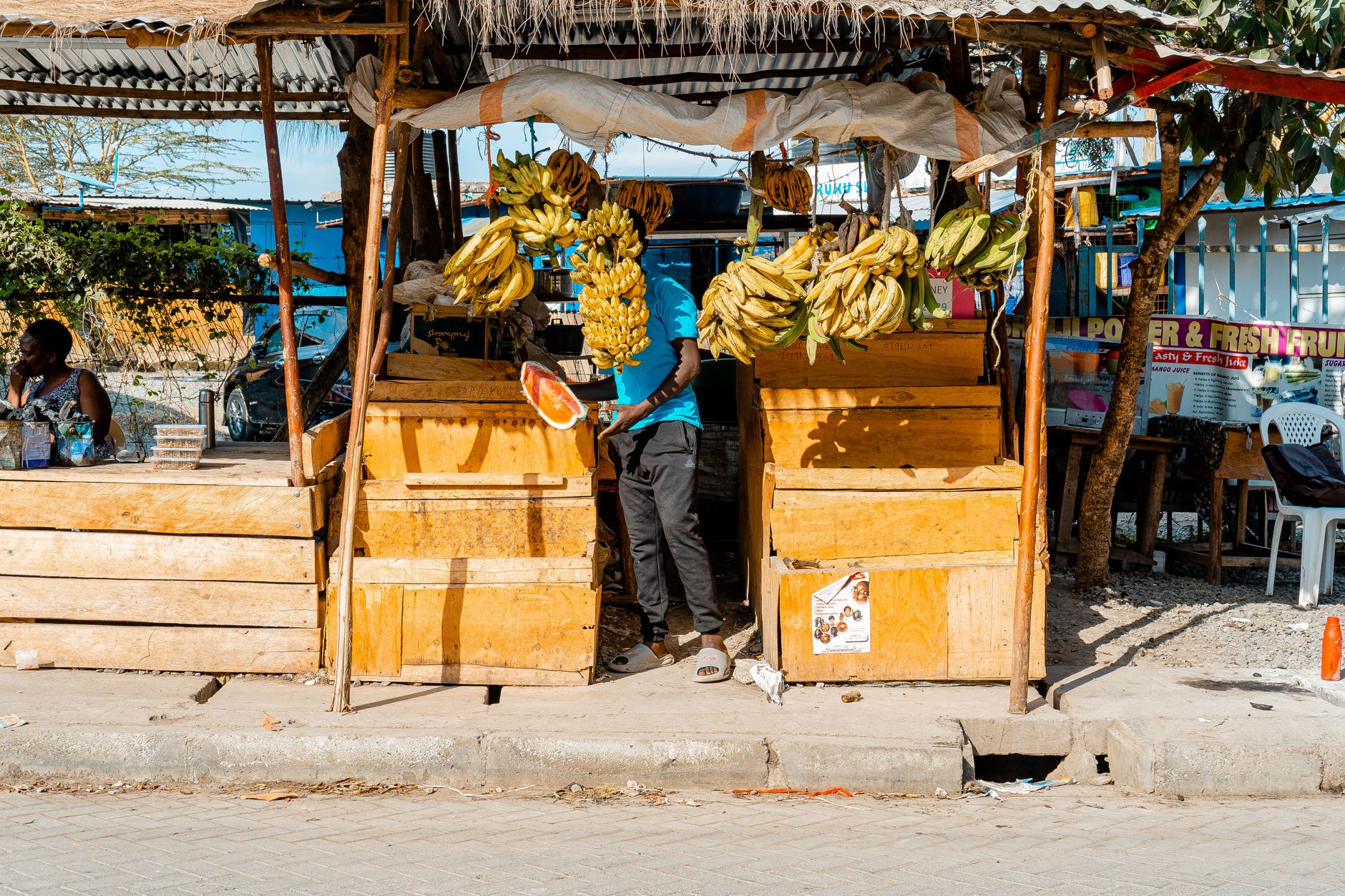
For everyday produce shopping without the intensity, neighbourhood markets serve better. Kilimani has stalls along Argwings Kodhek and near Yaya Centre; Westlands has traders around Sarit and along Ring Road; Karen and Lang’ata have roadside stands selling avocados at KSh30 each, mangoes at KSh50, and passion fruit by the bag. A week's fruit and vegetables for two costs KSh1,500 to KSh2,500 at these, which is a strong argument for booking a Kilimani or Westlands apartment with a kitchen rather than eating out three times a day.
Kazuri Beads and the craft workshops
Kazuri Beads in Karen, on Mbagathi Ridge, is a workshop rather than a market but belongs in any shopping itinerary. Founded in 1975, it employs mostly single mothers to hand-roll and hand-paint ceramic beads, and you can walk the production floor for free before buying in the shop. Necklaces run KSh1,500 to KSh4,000, bracelets from KSh800, and the pottery line offers plates and mugs from KSh700. Prices are fixed, quality is consistent, and the provenance is real. It pairs naturally with the Giraffe Centre and Karen Blixen Museum in a single Karen morning.
Two other fixed-price craft options are worth knowing when you tire of haggling. Utamaduni Craft Centre, also in Karen on Bogani East Road, spreads across a two-storey house with a dozen shops selling textiles, jewellery, carvings and books, with a garden café attached. The Village Market craft section in Gigiri, alongside the Friday Maasai market, offers similar. Fixed prices run 30 to 50 per cent above a well-negotiated Maasai market outcome, which many visitors happily pay for the certainty and the quality control.
Market practicalities: cash, timing, transport
Bring cash in KSh100 and KSh200 notes plus M-Pesa. Nobody at a market stall takes cards, and producing a KSh1,000 note for a KSh300 purchase means either no change or a long wait while a runner is dispatched. Carry a canvas bag; plastic carrier bags are banned in Kenya and traders will not have one. Mornings are consistently better across every market — cooler, fresher stock, fewer crowds — and by 4pm the produce markets are winding down while the curio markets get pushier.
Getting there: City Market and the CBD markets are walkable from Kenyatta Avenue but drive or ride-hail rather than arriving loaded with shopping. Toi is a KSh400 to KSh600 ride-hail from Kilimani. Village Market in Gigiri is KSh700 to KSh1,000 from Westlands. Junction Mall and Yaya are straightforward from anywhere on Ngong Road or Kilimani. On negotiation, one rule beats all others: decide your walk-away price before you open your mouth, say it once, and be genuinely prepared to leave. That is the entire skill.
Questions, answered
Where is the Maasai market in Nairobi and when is it open?
It rotates daily. Tuesdays at Kijabe Street near the Globe roundabout, Wednesdays at Capital Centre on Mombasa Road, Thursdays at Junction Mall on Ngong Road, Fridays at Village Market in Gigiri, Saturdays at the High Court car park in the CBD, and Sundays near Yaya Centre in Kilimani. Locations occasionally shift, so confirm locally. Most run roughly 8am to 5pm.
How much should I bargain at Nairobi markets?
At the Maasai market and curio stalls, opening quotes run three to four times the settle price, so aim to land at 30 to 40 per cent of the first ask. A shuka quoted at KSh3,000 should settle near KSh1,000. Bargain in good humour, name your walk-away price once, and be prepared to leave. Kazuri Beads and Utamaduni are fixed-price.
Is Gikomba market safe for tourists?
It is Nairobi's largest open-air market and extremely intense — dense crowds, uneven ground, and a history of fires. Visitors should go only with a local guide, in the morning, carrying nothing valuable. Toi Market off Ngong Road offers a very similar second-hand clothing experience at a manageable scale and is fine to visit independently by day with normal caution.
What can I buy at City Market Nairobi?
Cut flowers — Kenyan roses at KSh300 to KSh600 a bunch — plus fresh fish, meat, produce on the ground floor, and soapstone, wood carvings, beadwork and baskets in the upper galleries. It sits on Muindi Mbingu Street in the CBD, opens roughly 7am to 6pm Monday to Saturday, and curio prices are highly negotiable, often settling at a third of the first quote.
Do Nairobi markets take card or M-Pesa?
M-Pesa yes, almost universally, via a till number. Cards essentially never, outside fixed-price craft centres like Kazuri Beads and Utamaduni in Karen. Bring cash in KSh100 and KSh200 notes since traders rarely have change for KSh1,000. Also bring a reusable bag — plastic carrier bags are banned in Kenya and stalls will not supply one.
Doing good is the business: every booking through Stay Nairobi funds one verified tonne of carbon removal — same room, same price, no markup.
Start your search