
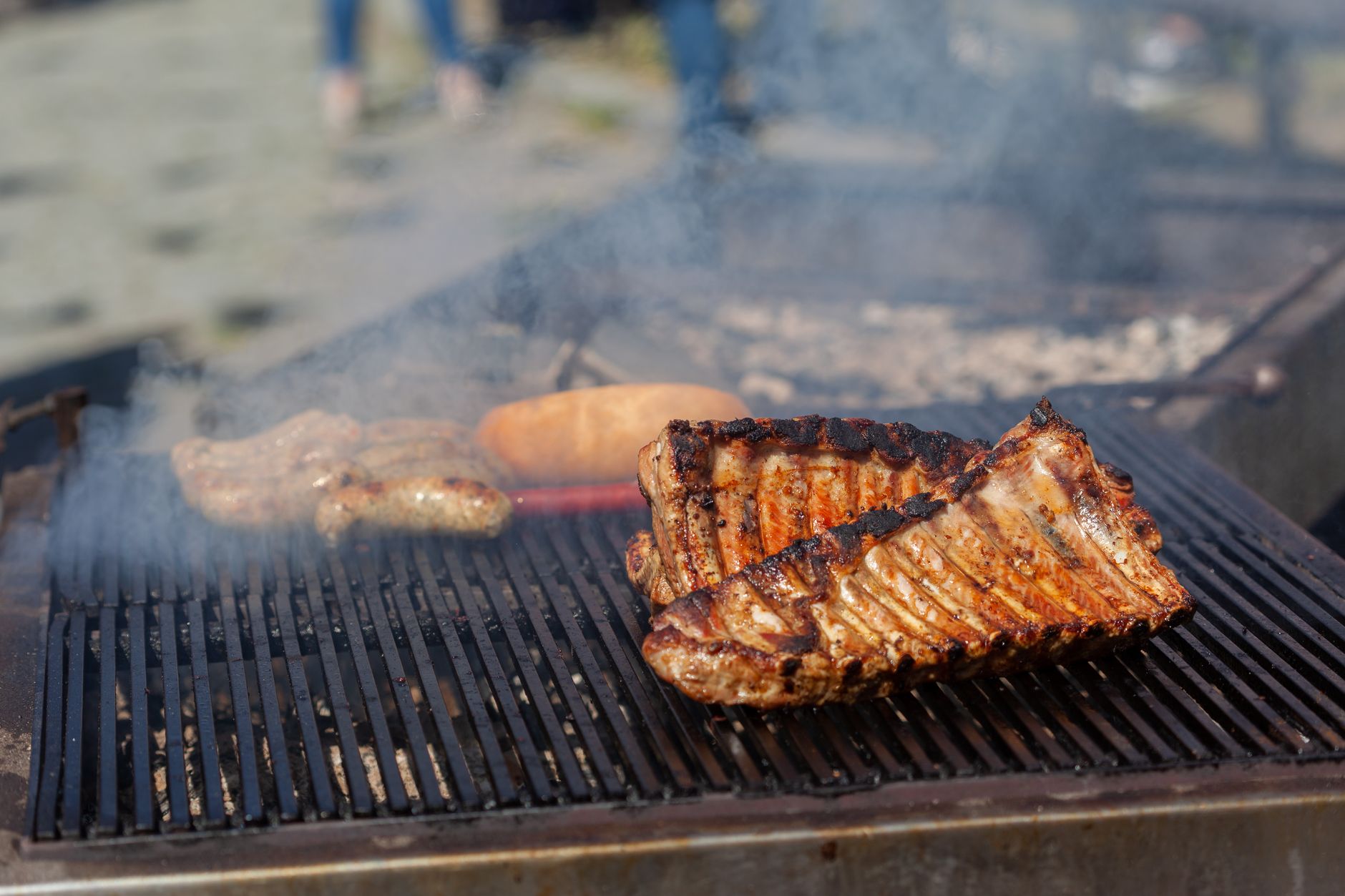
Nyama choma: the national ritual
Nyama choma means roast meat, and in Nairobi it means goat or beef ribs salted and grilled slowly over charcoal, then chopped on a wooden board with a heavy knife and served with kachumbari — a raw salad of tomato, red onion, chilli and coriander — plus ugali. You order by weight. Goat runs KSh700 to KSh1,200 a kilo depending on the venue; a kilo comfortably feeds two. The classic experience is a large open-air joint with a butchery counter at the front where you pick your cut, then wait 40 minutes with a beer while it cooks.
The Ngong Road corridor, the Kiserian and Dagoretti areas, and the roadside joints along Lang’ata Road are the traditional heartland. Westlands has slicker versions at higher prices, KSh1,400 or more a kilo, with better seating and worse charcoal. The rule of thumb is that the smokier and less designed the place, the better the meat. Order mutura — a grilled blood-and-offal sausage, KSh50 to KSh100 a piece — while you wait, and ask for the ribs rather than the leg if you want fat and flavour.
Ugali, sukuma wiki and the everyday plate
Ugali is stiff white maize meal, cooked to a firm, sliceable block, and it is the carbohydrate that most of Kenya eats daily. It has almost no flavour of its own — the point is to tear a piece, shape it with your right hand and use it to scoop stew. Sukuma wiki, collard greens fried with onion and tomato, is its constant partner. A plate of ugali, sukuma and beef stew at a neighbourhood kibanda costs KSh250 to KSh450 and is the single best-value meal in Nairobi.
Other staples worth ordering: githeri, a Kikuyu boiled mix of maize and beans, often fried up with onion and potato, KSh200 to KSh350; mukimo, mashed potato with peas, maize and greens, a Central Kenya dish that turns bright green and pairs with roast meat; and matumbo, tripe stewed slowly, an acquired texture but a Nairobi staple. Kibandas open early for breakfast and close by mid-evening. Look for the ones full of office workers at 1pm — that is the entire quality signal you need.
Swahili coast cooking in the capital
Nairobi eats a lot of coastal food, and it is the most spice-driven cuisine in the country. Pilau is rice cooked in a broth with cumin, cardamom, cloves and cinnamon, usually with beef or chicken, and it should be brown and separate rather than sticky. Biryani is its richer cousin, layered and served with a tomato-onion sauce. Coconut is everywhere: wali wa nazi is coconut rice, and mchuzi wa samaki puts fish in a coconut and tamarind curry. Expect KSh500 to KSh900 a plate at a good Swahili restaurant.
Parklands, Eastleigh and parts of South C have the highest density of coastal and Somali cooking in the city. Order viazi karai — battered deep-fried potatoes with a tamarind chutney, KSh100 to KSh200 — and mahamri, cardamom-scented triangular doughnuts eaten with sweetened beans at breakfast. Somali restaurants add camel meat, suqaar and heaped plates of rice with banana on the side, an unlikely combination that works. Portions in these places are large and prices low; two people can eat well for KSh1,200.
Street food: what to order and where
Smokie pasua is Nairobi's defining street snack — a sausage split lengthways, filled with kachumbari and a squeeze of chilli sauce, served from a cart with an insulated box, KSh50 to KSh80. Mutura, the grilled sausage of offal and blood, goes for KSh50 a slice at evening stalls. Mahindi choma, roast maize cobs rubbed with chilli and lime, appears on street corners across the city for KSh30 to KSh50 and is the best cheap thing you can eat while walking.
Chapati, the flaky East African flatbread, is sold everywhere at KSh20 to KSh40 and is the base of the beloved chapo-madondo combination — chapati with stewed brown beans, KSh150 to KSh250, a filling breakfast. Samosas, sold from glass cases at kiosks, cost KSh40 to KSh70 and are usually beef or lentil. Rule for street food: eat where it comes off the heat in front of you, at busy stalls with turnover, and skip anything sitting lukewarm in a case since mid-morning.
Indian-Kenyan cooking, which is a cuisine of its own
Kenya's South Asian community has been here for over a century and its cooking is genuinely Kenyan rather than imported. Parklands, along 3rd Parklands Avenue and Limuru Road, and parts of Westlands are where to find it. Order bhajia — spiced sliced potato in gram flour batter, KSh250 to KSh400, served with a coriander and tamarind chutney, and a Nairobi obsession. Kuku paka is the crossover dish: grilled chicken in a coconut and coriander curry, coastal in origin, Indian in technique, KSh700 to KSh1,000.
Vegetarian thalis in Parklands run KSh600 to KSh1,000 and are excellent value. Nairobi also does a specific thing with fried fish — tilapia from Lake Victoria, deep-fried whole and served with ugali and a chilli sauce, at KSh600 to KSh1,000 for a decent-sized fish. Look for it at fish joints in Kibera's edges, along Ngong Road, and in the Kisumu-diaspora restaurants. It is one of the most satisfying meals in the city and rarely appears on hotel menus.
Drinks, and what to order with all this
Tusker lager is the default beer at KSh250 in a local bar and KSh450 to KSh600 in Westlands; White Cap and Pilsner are the other big domestics, and Nairobi's craft scene now produces decent IPAs at KSh500 to KSh700. Kenyan chai is tea brewed with milk, sugar and often ginger, served scalding at KSh50 to KSh100 from any kibanda. Coffee is Kenya's great export and its cafés have finally caught up — a flat white in a Kilimani or Westlands specialty roaster runs KSh350 to KSh500, using single-origin beans from Nyeri and Kirinyaga.
Non-alcoholic options worth trying: dawa, a hot honey-lime-ginger drink, KSh200 to KSh350, sold as a cold remedy and drunk as a nightcap; fresh sugarcane juice from street pressers at KSh50 to KSh100; and passion fruit juice, which in Kenya is genuinely fresh rather than concentrate. Muratina is the traditional fermented honey-and-sausage-tree drink, rarely served commercially but worth trying if offered. Avoid anything homebrewed and unlabelled sold cheaply on the street — chang’aa is illegal and dangerous.
Questions, answered
What is Kenya's national dish?
Ugali with sukuma wiki and a meat stew is the everyday national plate, eaten by hand at kibandas across Nairobi for KSh250 to KSh450. Nyama choma — charcoal-grilled goat or beef, ordered by the kilo at KSh700 to KSh1,200 — is the celebratory national dish and the one to build a meal around. Both are widely available across the city.
How much does a meal cost in Nairobi?
A local kibanda plate of ugali, greens and stew runs KSh250 to KSh450. Street snacks like smokie pasua or roast maize cost KSh30 to KSh80. A sit-down Swahili or Indian-Kenyan meal is KSh500 to KSh1,000 a head. A kilo of nyama choma with sides feeds two for KSh700 to KSh1,200. Westlands restaurants charge KSh1,500 to KSh3,500 a head.
Is street food safe in Nairobi?
Generally yes at busy stalls with high turnover, where food is cooked in front of you. Smokie pasua, mutura, roast maize and freshly fried samosas are all fine. Avoid anything sitting lukewarm in a glass case, unwashed raw salads at street level, and juice made with tap water or ice. Stick to bottled water alongside and you will be fine.
Where can I eat nyama choma in Nairobi?
The traditional belt runs along Ngong Road, out toward Dagoretti and Kiserian, and along Lang’ata Road, where open-air joints have butchery counters at the front. Pick your cut by weight, expect a 40-minute wait, and order mutura and a Tusker while it grills. Westlands versions cost more, from KSh1,400 a kilo, with better seating and less smoke.
What should vegetarians eat in Nairobi?
Parklands, along 3rd Parklands Avenue and Limuru Road, is the best area — vegetarian Indian-Kenyan thalis run KSh600 to KSh1,000. Locally, githeri (maize and beans) at KSh200 to KSh350, mukimo, sukuma wiki with ugali, chapati with madondo beans, and bhajia are all vegetarian staples. Westlands and Kilimani cafés also carry standard international vegetarian and vegan menus.
Doing good is the business: every booking through Stay Nairobi funds one verified tonne of carbon removal — same room, same price, no markup.
Start your search