
Cultural Landmarks
Kenyatta International Convention Centre
Nairobi's defining tower, opened in 1974, and the only place you can stand on a helipad 28 floors up and see the city, the Ngong Hills and the national park in one turn of the head.
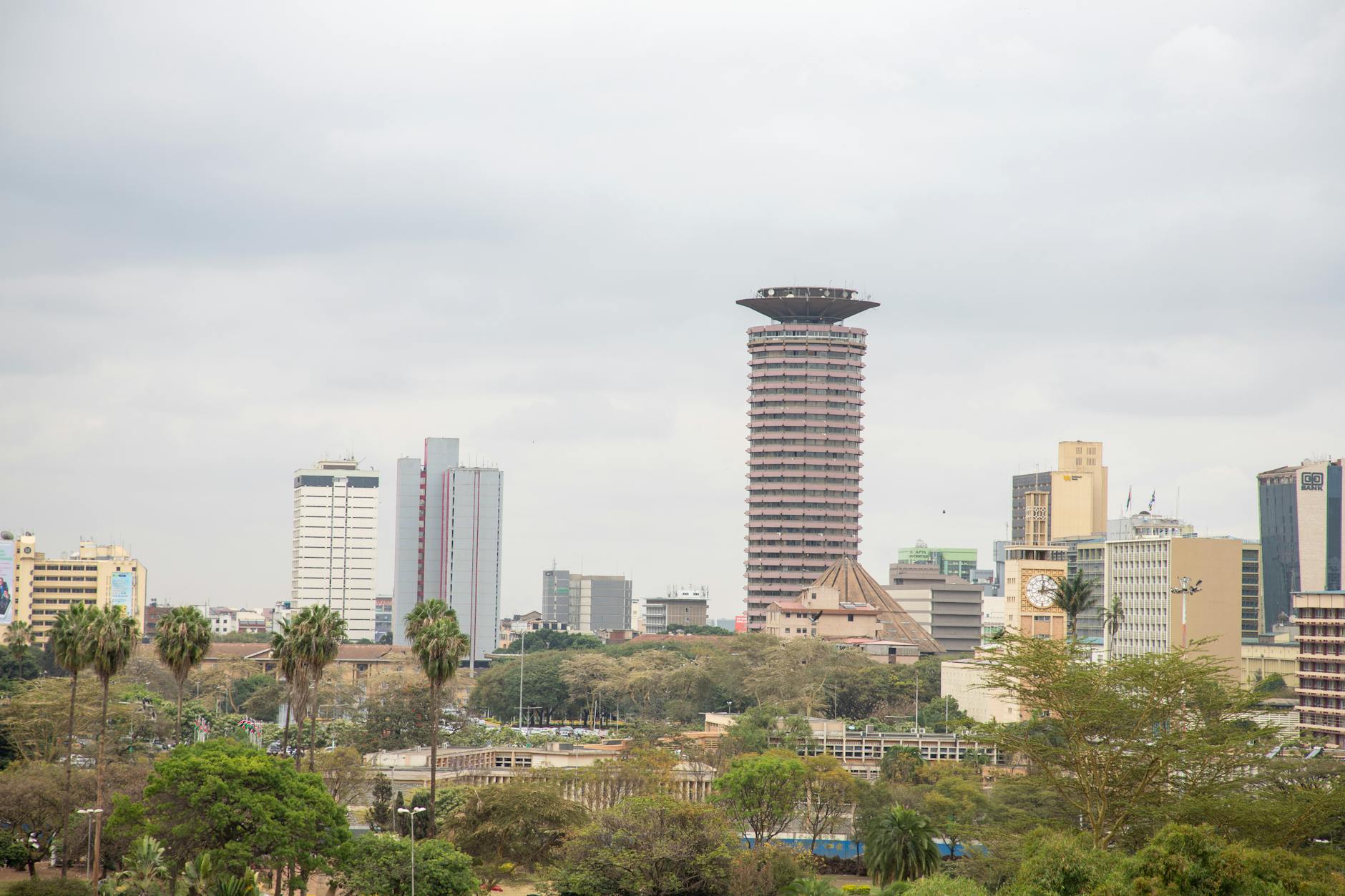
The Kenyatta International Convention Centre is the building that means Nairobi. Its cylindrical 28-storey tower, capped by a rooftop helipad, and the saucer-shaped plenary hall beside it were designed by the Norwegian architect Karl Henrik Nostvik with Kenyan input and completed in 1974, having been begun in the late 1960s as the headquarters of the ruling party and the country's showpiece conference venue. At roughly 105 metres it was for decades the tallest building in Kenya and it remains on the banknotes, the postcards and the logo of the city itself. The complex has hosted heads of state, United Nations conferences, national ceremonies and countless trade fairs; the amphitheatre and the podium in the forecourt are woven into Kenya's political memory. For visitors the draw is simpler: the public rooftop viewing deck, one of the best-value city panoramas in East Africa.
The visit is short and mostly vertical. You report to the ticket and security desk at the tower base off City Hall Way, pay, leave large bags, pass through screening and take the lift up 27 floors, then climb a final flight onto the helipad. The deck is open to the sky with a low parapet and a 360-degree view: the CBD's towers below, the green mass of Uhuru Park and Central Park to the west, the Ngong Hills on the horizon, the plains of Nairobi National Park to the south with aircraft dropping into Wilson and Jomo Kenyatta, and Westlands and Parklands rising to the north. Staff often point out landmarks. On the way out, the forecourt, the plenary hall exterior and the Jomo Kenyatta statue are worth a slow lap.
Plan an hour, less if you are brisk. There is no booking for the viewing deck; you arrive, pay and go up. Bring photo identification, since this is a government-managed complex with real security, and expect a bag check. Tripods and drones are not casually permitted. Skip the interior of the conference halls, which are not open to sightseers except during public events, and skip the visit entirely on a low-cloud morning, because the whole point is the horizon. Do fold in a walk across to Uhuru Park afterwards, five minutes west, which is the classic Nairobi combination and free.
The KICC stands on City Hall Way at Harambee Avenue, in the government quarter of the CBD. From Kenyatta Avenue it is a five-minute walk; from Moi Avenue and the Hilton eight; from the Railway Station about fifteen; from Nairobi Gallery ten. The Kencom stage, where a large share of the city's matatu routes terminate, is five minutes away, and fares from the suburbs sit in the KSh50-120 range. Ride-hailing costs roughly KSh350-600 from Kilimani or Upper Hill, KSh400-700 from Westlands and KSh900-1,500 from Karen in traffic. There is paid parking around the complex and in nearby basements, charged by the hour and busy on weekday mornings, but the CBD is so walkable that driving here is usually a mistake.
Rooftop access is ticketed and tiered. Non-residents generally pay in the region of KSh1,000 for adults with children less, while Kenyan citizens and residents pay a lower rate, typically a few hundred shillings. Payment is at the desk and mobile money is widely accepted; carry cash as backup. Group and school rates are negotiated in advance. Commercial photography, filming and drone work require written permission and separate fees through the KICC management, and this is enforced. There is nothing else to pay for on the deck: no cafe, no telescope, no gift shop, though the ground-floor and forecourt businesses sell drinks and snacks. Rates are reviewed from time to time and the desk is the authority, so check on arrival rather than relying on an old blog figure.
Timing decides everything here. The clearest air is in the first two hours after 8:00 and again in the last hour before 18:00, when the light is low and the Ngong Hills are sharpest; the middle of the day flattens the view into haze. Sunset from the helipad is the best hour of all and correspondingly the busiest. Weekdays are quieter than weekends. Conferences and national events can restrict public access at short notice, which is the one thing to phone about if you are making a special trip. Seasonally, the dry, clear stretches of January to early March and July to October give the reliable horizons; during the April-May long rains the deck closes in heavy weather and the hills disappear for days.
It suits almost everyone with a head for heights and an hour to spare, and it suits photographers best of all. Families do well, though the open helipad with its low parapet demands that children are held firmly and never put on shoulders. Teenagers love it. Wheelchair users can reach the tower lifts and the 27th-floor level, but the final flight of steps onto the helipad itself is stairs only, so the very top is not accessible; ask at the desk about what can be seen from the lift landing. Anyone terrified of exposed heights should skip it, as should visitors on a grey, low-cloud day, when you will pay full price to stand inside a cloud.
Everything worth doing in the CBD is within fifteen minutes on foot. Uhuru Park is five minutes west across the road for grass, boating and the skyline view from below; the Kenya National Archives is eight minutes east on Moi Avenue; Nairobi Gallery is ten minutes west at the top of Kenyatta Avenue; the August 7th Memorial Park is ten minutes east; the Railway Museum is fifteen minutes south-west; and City Market's craft and food stalls are ten minutes north-west. Build the whole day on foot from a CBD hotel and you will spend almost nothing on transport, which is the honest case for spending part of a Nairobi week downtown rather than commuting in daily from Karen or Runda.
The honest caveats. This is not a purpose-built observation tower and it does not pretend to be: the deck is a working helipad with a functional parapet, there is no glass, no cafe and no interpretation beyond whatever the attendant tells you. Access is occasionally suspended for state functions, VIP movements, maintenance or bad weather, sometimes with no warning, and there is no compensation beyond a refund. The lift queue can crawl during conferences when the tower's office tenants are all moving. Security is genuine, so leave the drone at the hotel. And do not expect to tour the famous plenary hall or the amphitheatre; on an ordinary day, the public part of the KICC is the lift, the view and the forecourt.
Hours & entry
Not free
Daily 8:00-18:00 for rooftop access · Ticket office Mon-Fri 8:00-17:00 · Weekend access via security desk
What to see
{'what': '360-degree rooftop panorama', 'where': 'Helipad deck, top of the 28-storey tower'}
{'what': 'Ngong Hills and Nairobi National Park horizon', 'where': 'South-western edge of the helipad'}
{'what': 'Jomo Kenyatta statue and amphitheatre', 'where': 'Forecourt off City Hall Way'}
Tips from the ground
Go in the first two hours after 8:00 or the last hour before 18:00 for clear air.
Carry photo ID; this is a secured government complex with bag screening.
Skip it on a low-cloud morning; the ticket buys a view, not a building tour.
Questions, answered
How much is the KICC rooftop?
Non-resident adults generally pay around KSh1,000, with children less, while Kenyan citizens and residents pay a lower rate of a few hundred shillings. You pay at the ticket and security desk at the tower base off City Hall Way, and mobile money is usually accepted alongside cash. Nothing else on the deck costs money, but commercial photography, filming and drones need written permission and separate fees. Confirm the current figure at the desk, as rates are revised periodically.
Can you go up for free?
No. Rooftop access is ticketed every day, and there is no free hour, free day or resident free window. The forecourt, the Jomo Kenyatta statue and the exterior of the plenary hall can be walked and photographed without charge, which is the only free part of the complex. Conference delegates and building tenants have their own access arrangements that do not extend to sightseeing on the helipad, so visitors should budget for the ticket.
How long does the visit take?
Around an hour door to door. Allow 10-15 minutes for the ticket desk, security screening and the lift, 20-30 minutes on the helipad taking photographs and identifying landmarks, and another 10-15 minutes for the forecourt and statue on the way out. During conferences the lift queue can add 20 minutes. If you are only after the view and the light is good, a tight 35-minute visit is entirely feasible.
Is it ever closed?
Nominally it opens daily, roughly 8:00 to 18:00 for rooftop access, but this is a working government conference complex and access is suspended without notice for state functions, VIP helicopter movements, maintenance and heavy weather. The ticket office keeps standard weekday hours, with weekend access handled through the security desk. If you are travelling across the city specifically for the view, telephone the day of your visit rather than relying on posted hours.
Do I need to book?
Individual visitors do not book; turn up at the desk with photo identification, pay and go up. Advance arrangements are needed for groups and school parties, which get negotiated rates, and for any commercial photography, filming or media access, which requires written permission from KICC management. Because closures are unpredictable, a phone call on the morning of your visit is more useful than a booking would be.
What is the nearest stop?
The Kencom stage on Moi Avenue, where a large share of Nairobi matatu routes terminate, is a five-minute walk, with fares from the suburbs typically KSh50-120. Kenyatta Avenue is five minutes away and the Railway Station about fifteen on foot. Ride-hailing costs roughly KSh350-600 from Upper Hill or Kilimani and KSh400-700 from Westlands. Paid parking exists around the complex and in nearby basements but fills on weekday mornings.
Doing good is the business: every booking through Stay Nairobi funds one verified tonne of carbon removal — same room, same price, no markup.
Start your search